

XPS Board Production Line
Green Earth provides CO2 XPS board production lines configured around your target capacity, board specifications, raw materials and factory conditions. From core extrusion equipment to cooling, cutting, recycling and automation, the line can be developed to support new insulation board plants and capacity expansion projects.
Need help planning your production line? Work with a Plastic Plant Engineering Company to evaluate your process and project requirements.
Ready to discuss your XPS project? Request a Technical Proposal →
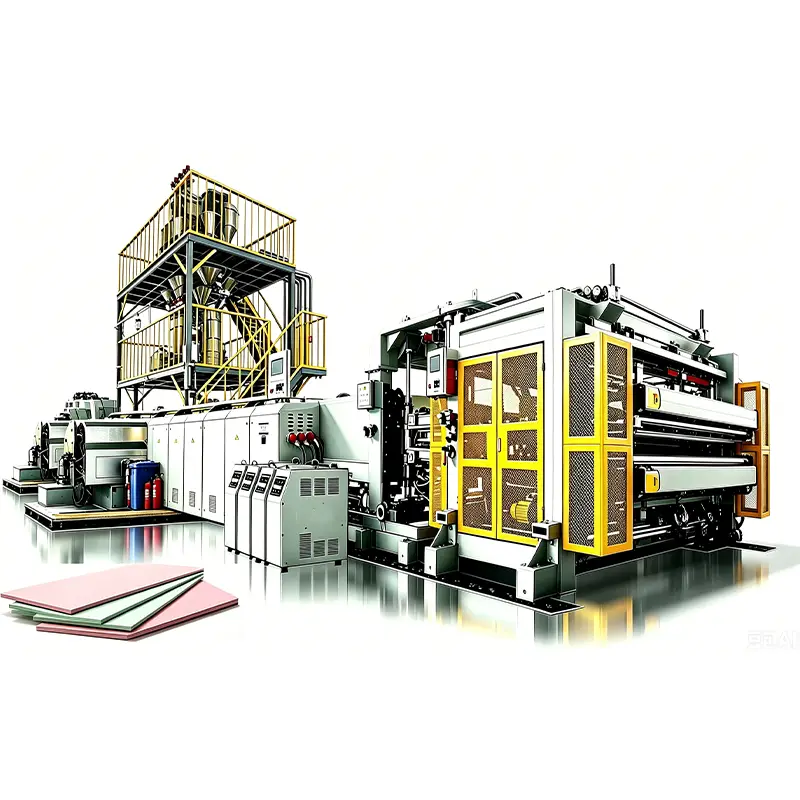
CO2 XPS Board Production Lines for Turnkey Insulation Plants
Green Earth supplies CO2-based XPS production systems for manufacturers planning new insulation board plants, capacity expansion or selected line upgrades. Line configuration can be developed around target output, board width and thickness, density, compressive strength, thermal performance, blowing-agent requirements, recycled material ratio and local plant conditions.
Published line models cover output levels from 700 to 2,400 kg/h. Depending on the project, the system can integrate raw-material handling, extrusion, foaming, shaping, cooling, cutting, edge processing, stacking, packaging, recycling and process control.
The final configuration should be determined from the required finished-board specifications and verified process conditions rather than maximum machine capacity alone.
Available XPS Line Model Range
The following models represent Green Earth's current published capacity range. Final board dimensions, installed power, utilities, equipment footprint and auxiliary configuration should be confirmed during technical engineering.
| Model | Current Published Output | Configuration Notes |
|---|---|---|
| GE75-200 | 700 kg/h | Confirm board range, installed power, footprint and utilities |
| GE95-250 | 900 kg/h | Confirm board range, installed power, footprint and utilities |
| GE110-300 | 1,300 kg/h | Confirm board range, installed power, footprint and utilities |
| GE135-400 | 2,000 kg/h | Confirm board range, installed power, footprint and utilities |
| GE150-500 | 2,400 kg/h | Confirm board range, installed power, footprint and utilities |
Capacity should be selected according to the expected annual volume, operating days, shifts, product mix, utilization rate and future expansion plans. Maximum nameplate output is only one factor in selecting an XPS Board Production Line.
Core Line Modules
A complete XPS foam board production line combines multiple process stages rather than relying on the extrusion unit alone. The equipment scope can be adjusted according to the required board specifications, production capacity and plant conditions.
Raw Material Handling and Feeding
Automatic conveying and feeding systems can be configured for consistent material delivery to the extrusion process. Depending on the material and formulation, loss-in-weight or gain-in-weight feeding can be incorporated for controlled dosing of polymer and additives.
Primary and Cooling Extrusion
The extrusion section can combine a high-torque twin-screw primary extruder with a high-efficiency cooling extrusion stage. Screw configuration, temperature control and throughput are selected according to the required formulation and process conditions.
CO2 Blowing-Agent System
A controlled CO2 blowing-agent metering and injection system can be integrated according to the confirmed foaming process. The blowing-agent strategy needs to be evaluated together with density, cell structure, thermal performance, product thickness and other finished-board requirements.
Die and Board Forming
The die, calibration and shaping system determines how the extruded foam is formed into the required board dimensions. Board width, thickness, density and edge profile should therefore be confirmed before finalizing the forming configuration.
Cooling, Traction and Cutting
Cooling and traction systems stabilize the board during production before trimming and cutting. The line can integrate longitudinal trimming, grooving and cross-cutting according to the finished-board requirements.
Edge Processing and Packaging
Depending on the finished product, optional equipment can include four-side milling, stacking and packaging systems. These modules can be configured around the required edge profile, packaging format and production workflow.
Scrap Recycling and Dust Collection
Online edge-scrap recycling can help recover suitable production waste for controlled reuse. Dust collection and material-handling systems can also be incorporated according to the process and plant requirements.
Control and Process Monitoring
PLC or DCS-based control can coordinate key production parameters across the line. Depending on the project scope, functions may include recipe records, alarm history, process monitoring and remote diagnostics.
What the Finished Board Specification Determines
The finished XPS board specification directly affects equipment selection and process configuration. A production line should therefore be designed around the required product rather than selected solely according to extrusion capacity.
| Finished Board Requirement | Impact on Line Configuration |
|---|---|
| Board Width | Influences die width, shaping, cooling and downstream handling |
| Board Thickness | Affects die, forming, cooling and cutting configuration |
| Density | Influences formulation, extrusion conditions and foaming process |
| Compressive Strength | Affects material formulation and process parameters |
| Thermal Conductivity | Influences cell structure, density and blowing-agent strategy |
| Dimensional Stability | Affects cooling, shaping and process control |
| Surface Treatment | Determines downstream finishing requirements |
| Edge Profile | Influences trimming, grooving and milling equipment |
| Recycled Material Ratio | Requires evaluation of feedstock quality and process stability |
| Production Capacity | Determines extrusion and auxiliary equipment sizing |
For projects using recycled PS, the feasible recycled content should be evaluated based on material purity, melt flow characteristics, moisture, volatile content, additives and the required finished-board properties.
CO2 XPS Extrusion Process
The CO2 XPS extrusion process requires coordinated control of polymer melting, additive dosing, blowing-agent injection, cooling, foaming and board shaping. Process parameters need to be balanced to achieve the required density, cell structure, thermal performance and dimensional stability.
For projects specifying a supercritical CO2 XPS extrusion line, the blowing-agent system and process conditions should be confirmed according to the selected technology, material formulation and target product specifications.
Rather than applying a fixed configuration to every project, Green Earth evaluates the production requirements before determining the appropriate extrusion, cooling, die and auxiliary systems.
Turnkey XPS Board Manufacturing Plant
A complete XPS project involves more than the production line itself. Green Earth can coordinate equipment and project requirements across different stages of plant development according to the agreed scope.
Feasibility and Process Planning
Initial project evaluation can consider the target product, production capacity, raw materials, utilities, factory conditions and local requirements.
Process Flow and Plant Layout
Process flow and equipment layout inputs can be developed around the selected line configuration, material flow and available factory space.
Main Equipment and Auxiliaries
The project scope can cover the extrusion line and relevant auxiliary systems, including feeding, cooling, cutting, recycling, dust collection, stacking and packaging.
Installation and Commissioning
Installation guidance, cold commissioning and hot commissioning support can be included according to the agreed project scope and site conditions.
Recipe and Process Support
Recipe development and process optimization should be based on the selected raw materials, finished-board specifications and production conditions. Production trials may be required to validate performance.
Training and After-Sales Support
Operator training, technical documentation, spare parts, warranty and remote technical support can be defined as part of the project scope.
For a complete project assessment, see our industrial polymer production equipment solutions or contact Green Earth with your production requirem
XPS Insulation Board Production Applications
XPS production systems are used to manufacture rigid extruded polystyrene insulation boards for construction and industrial insulation applications.
Building Wall Insulation
XPS boards can be produced for thermal insulation applications in exterior and interior wall systems, subject to the required product specifications and local building standards.
Roof Insulation
The production line can be configured for board specifications used in roof insulation applications, with density, compressive strength and dimensional stability considered during product development.
Floor and Foundation Insulation
Higher-strength XPS boards can be developed for floor, foundation and other applications where mechanical performance is an important product requirement.
Cold Storage and Refrigeration
XPS insulation boards can also be used in cold-storage and refrigeration-related applications where thermal insulation performance and dimensional stability are required.
XPS Line Configuration and Project Inputs
Before selecting an XPS insulation board extrusion line, customers should provide as much of the following information as possible:
- Target production capacity
- Annual production target
- Board width and thickness
- Target density
- Compressive strength requirements
- Thermal conductivity target
- Required surface and edge profile
- Raw material type
- Virgin and recycled material ratio
- Additive requirements
- Blowing-agent requirements
- Available factory dimensions
- Electrical power and other utilities
- Local technical and safety standards
- Automation requirements
- Target delivery and commissioning date
These inputs help determine whether the proposed XPS insulation board production equipment can meet the required production and product targets.
XPS Insulation Board Plant Cost
The total investment for an XPS insulation board plant depends on much more than the nominal extrusion capacity. Key cost factors can include the selected line model, board size range, automation level, blowing-agent system, auxiliary equipment, recycling system, utilities, local standards, freight, installation, civil works and commissioning requirements.
For this reason, a reliable XPS insulation board plant cost estimate should be prepared after the product specifications, production capacity, factory conditions and project scope have been confirmed.
Why Choose a Project-Based XPS Line Configuration?
A production line should be matched to the actual manufacturing objective. Selecting a machine only by maximum output can lead to an unsuitable configuration if the required board range, density, thermal performance or downstream processing requirements are different.
Green Earth's project-based approach considers:
- Finished-board specifications
- Required production capacity
- Raw material characteristics
- CO2 foaming requirements
- Recycled material ratio
- Factory and utility conditions
- Automation requirements
- Auxiliary equipment
- Installation and commissioning scope
This approach allows the XPS board manufacturing machine and supporting systems to be configured around the intended production process.
Frequently Asked Questions
What capacity should we choose for an XPS production line?
Capacity should be based on annual sales volume, operating days, shift pattern, product mix, expected line utilization and future expansion plans. Maximum nameplate output should not be the only selection criterion.
What is the difference between an XPS board machine and a complete production line?
An XPS board machine may refer to the core extrusion and forming equipment, while a complete production line can include raw-material handling, extrusion, foaming, cooling, shaping, cutting, edge processing, recycling, stacking, packaging and control systems.
Can recycled PS be used in XPS board production?
Potentially, but the feasible recycled material ratio depends on recycled PS purity, melt flow characteristics, moisture, volatile content, additives and required board properties. Material testing and production trials are recommended before confirming the formulation and recycled content.
What affects XPS plant cost?
Capacity, board size range, extrusion configuration, blowing-agent system, automation, auxiliary equipment, local standards, utilities, freight, installation, civil works and commissioning all contribute to total project investment.
Can the line produce different XPS board thicknesses?
The feasible board range depends on the selected extrusion, die, calibration, cooling, traction and cutting configuration. Required thickness and width ranges should be confirmed during technical engineering.
Can the XPS production line be customized for our factory?
Yes. Equipment arrangement and auxiliary configuration can be developed around available factory dimensions, utilities, material flow and local installation requirements. Final layout should be confirmed during detailed engineering.
Do you provide turnkey XPS production projects?
The project scope can include feasibility inputs, process flow, equipment and auxiliaries, plant layout inputs, installation guidance, commissioning, training, spare parts and after-sales support according to the agreed quotation and contract.
Request an XPS Production Line Proposal
Planning a new XPS insulation board plant or expanding an existing production line? Send Green Earth your target capacity, board specifications, raw material information, recycled material ratio and factory conditions.
Our team can evaluate the requirements and recommend a suitable XPS Foam Board Production Line configuration.