

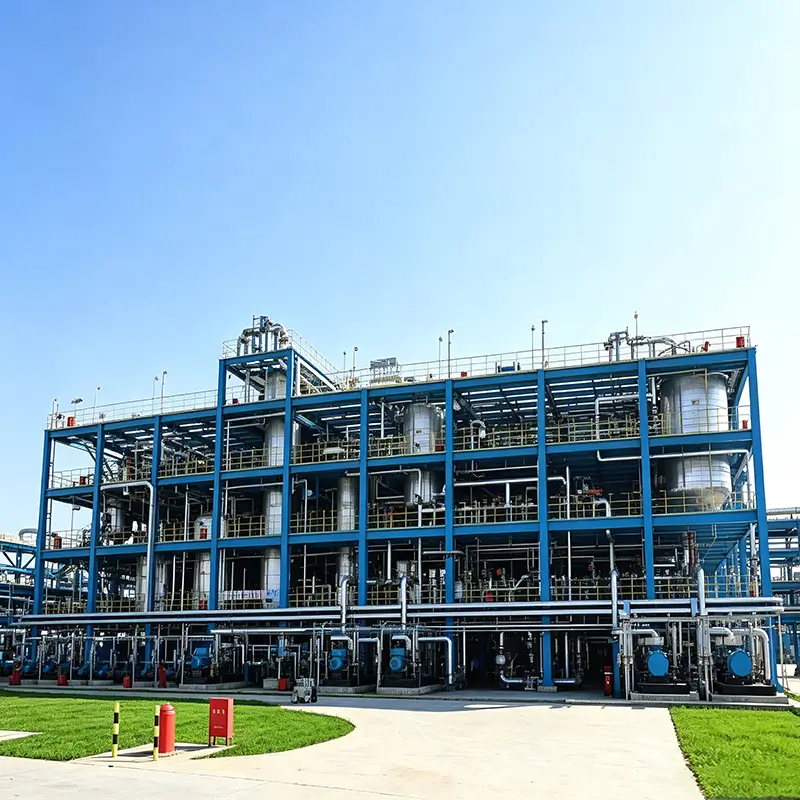
Styrene Monomer Production Plant
Product Overview
Green Earth's styrene production unit is an industrial production system designed for the continuous production, separation and purification of high-purity styrene monomer (SM).
Styrene monomer is a key feedstock for manufacturing styrene-based polymers, including GPPS, HIPS, ABS and MS resin. The plant integrates raw material preparation, reaction, separation, recovery, purification, product storage and intelligent process control into a coordinated production system.
Designed for petrochemical and polymer manufacturing projects, the styrene production unit can be configured according to production capacity, feedstock conditions, required product purity, utility availability and downstream resin production requirements. Its continuous process design supports stable operation, efficient material utilization and consistent styrene monomer quality.
Styrene Monomer Production Process
The production system is designed around an integrated reaction, separation and purification process. A typical configuration includes the following stages.
1. Raw Material Preparation
Benzene and ethylene are accurately metered and transferred through a closed feed system.
High-precision pumps, flow meters and control valves regulate material flow according to the process requirements. Feedstock quality is monitored before entering the reaction section to maintain stable operating conditions.
2. Ethylbenzene Formation
Benzene and ethylene are processed through a controlled alkylation section to produce ethylbenzene.
The reaction system incorporates temperature control, pressure monitoring and efficient material mixing. Heat exchange equipment helps maintain the required reaction conditions and supports stable conversion.
3. Dehydrogenation Reaction
The ethylbenzene stream is transferred to the dehydrogenation section, where controlled high-temperature conditions convert ethylbenzene into styrene monomer.
The reaction section is equipped with appropriate heating, heat exchange and process monitoring systems to maintain stable operating conditions and improve styrene production efficiency.
4. Product Separation
The reaction product contains styrene together with unconverted ethylbenzene, water, light components and heavier compounds.
A multi-stage separation system separates these components according to their physical and chemical properties. Recoverable materials can be returned to the relevant process section to improve overall material utilization.
5. Styrene Refining
Crude styrene enters the refining section for further purification.
Distillation columns, condensers, reboilers and reflux systems remove residual ethylbenzene, light components, heavy components and other impurities. Controlled refining helps achieve the required styrene monomer purity for downstream polymer manufacturing.
6. Product Stabilization and Storage
Because styrene monomer can undergo unwanted polymerization during storage, the finished product requires appropriate stabilization and storage conditions.
The refined styrene is transferred to dedicated storage tanks with suitable temperature monitoring and inhibitor management systems to maintain product stability.
7. Filtration and Product Transfer
Before final storage or shipment, the styrene monomer can pass through a precision filtration system to remove residual solid contaminants.
The finished product is then transferred to dedicated storage or loading facilities for transportation to downstream polymer production plants.
Key Advantages of the Styrene Production Unit
Continuous Production Configuration
The plant uses a continuous production configuration for stable feed, reaction, separation and product transfer.
Continuous operation supports consistent process conditions and can improve production efficiency for large-scale petrochemical projects.
Precise Process Control
The plant can integrate a centralized DCS control system to monitor and regulate critical process parameters.
Key parameters include:
- Feed flow rate
- Reaction temperature
- Reaction pressure
- Material residence time
- Column temperature
- Reflux conditions
- Product purity
- Storage temperature
Automated control reduces manual intervention and helps maintain consistent operating conditions.
Efficient Heat Management
Heat exchange systems are integrated into the reaction and separation sections to manage process heat effectively.
For large-scale production, thermal integration can help reduce energy consumption and improve overall plant efficiency.
Material Recovery System
The separation and recovery system can recover reusable process components and return them to the appropriate process section.
This approach reduces raw material losses and improves overall feedstock utilization.
High-Purity Styrene Output
The refining section is designed to remove unwanted light and heavy components from crude styrene.
Stable purification conditions help provide high-quality styrene monomer for downstream production of GPPS, HIPS, ABS, MS and other styrenic materials.
Integrated Safety Protection
Industrial styrene production involves flammable hydrocarbons, high temperatures and pressurized process systems.
The plant can incorporate:
- Safety instrumented systems
- Emergency shutdown systems
- Pressure relief devices
- Explosion-proof electrical equipment
- Gas detection systems
- Process alarms and interlocks
- DCS monitoring
The final safety configuration is engineered according to project conditions, applicable standards and local regulations.
Main Equipment Configuration
The SM polymerization unit features a modular configuration covering raw material preparation, reaction, separation, refinement, and control.
A. Raw Material Feeding System
The feeding system is capable of accurately metering and conveying the required raw materials. It may include:
-
Storage tanks
-
Feed pumps
-
Metering equipment
-
Flow meters
-
Control valves
-
Static mixers
-
Process monitoring instruments The closed structure helps reduce material leakage and maintains stable feeding conditions.
B. Reaction System
The reaction section is the core process area of the unit. It may include equipment for ethylbenzene generation and subsequent dehydrogenation, as well as:
-
Reactors
-
Process heaters
-
Heat exchangers
-
Condensers
-
Temperature control systems
-
Pressure monitoring systems Equipment configuration is determined based on the selected process technology and target production capacity.
C. Separation and Recovery System
The separation section divides the reaction products into different components and recovers reusable materials. Main equipment may include:
-
Separation vessels
-
Distillation columns
-
Condensers
-
Reboilers
-
Vacuum equipment
-
Recovery tanks
-
Recovery pumps Efficient separation helps ensure the stable progression of downstream purification processes and reduces material loss.
D. Styrene Refining Unit
This refining unit is designed to achieve the required purity of styrene monomer. It may include:
-
Multi-stage distillation columns
-
Heat exchangers
-
Reflux systems
-
Condensers
-
Product storage tanks
-
Precision filters Process parameters can be continuously monitored to maintain stable product quality.
E. DCS and Safety Control System
The plant can be equipped with an integrated DCS and safety control architecture. This system monitors production parameters in real time and supports:
-
Automatic process control
-
Alarm management
-
Safety interlock devices
-
Emergency shutdown
-
Equipment monitoring
-
Production data recording This allows operators to centrally control the production process.
Styrene Monomer Quality Control
Styrene monomer quality directly influences downstream polymerization performance. The plant therefore incorporates multiple stages of separation, refining and process monitoring.
| Quality Parameter | Control Method |
|---|---|
| Styrene purity | Multi-stage refining |
| Residual ethylbenzene | Distillation |
| Light components | Separation and distillation |
| Heavy components | Bottom-product separation |
| Water content | Feed and process control |
| Solid impurities | Precision filtration |
| Product stability | Inhibitor and storage management |
Final specifications can be configured according to the requirements of the customer's downstream polymer production process.
Downstream Applications
The high-purity styrene monomer produced by the plant serves as an important feedstock for a wide range of styrenic polymer materials.
GPPS Production
Styrene monomer is used to produce general-purpose polystyrene for packaging, stationery, transparent products and consumer applications.
HIPS Production
Styrene is combined with a rubber phase during polymerization to produce high-impact polystyrene with improved impact resistance.
ABS Production
Styrene is one of the primary monomers used in ABS resin production, together with acrylonitrile and butadiene.
MS Resin Production
Styrene can be copolymerized with methyl methacrylate to produce transparent MS resin for optical, lighting and packaging applications.
Other Styrenic Materials
Styrene is also used in various copolymers, modified polymers and specialty styrenic materials.
Integration with Polymer Production
A styrene monomer plant can serve as an upstream production unit for an integrated polymer manufacturing project.
Green Earth can coordinate the plant configuration with downstream polymer production requirements, including raw material storage, material transfer, production capacity and process integration.
For customers planning a complete polymer manufacturing project, Green Earth provides polymerization plant engineering project solutions covering relevant production equipment and system integration.
Styrene Production and Polymer Processing
Styrene monomer is an upstream chemical feedstock rather than a finished polymer product.
After production and purification, the monomer can be supplied to downstream polymerization systems for GPPS, HIPS, ABS, MS and other styrenic resins.
Green Earth also provides polymer processing equipment for downstream extrusion, compounding and pelletizing applications.
This enables customers to coordinate upstream styrene supply with downstream polymer production and processing requirements.
Environmental and Energy Management
The plant can incorporate closed material transfer, vapor recovery and process gas treatment systems to reduce material loss and hydrocarbon emissions.
Recoverable process components can be recycled where technically appropriate, improving raw material utilization.
Heat exchange and thermal integration can also be considered during project engineering to improve energy efficiency across the reaction and separation sections.
Environmental protection equipment and emission-control systems should be configured according to plant capacity, process technology and applicable local requirements.
Turnkey Project Support
A commercial styrene production project requires coordinated engineering across reaction, separation, refining, storage, utilities, automation and safety systems.
Green Earth can provide project-oriented support covering:
- Process equipment configuration
- Production capacity planning
- Plant layout consultation
- Storage system design
- Material transfer planning
- Utility requirements
- DCS integration
- Safety system configuration
- Environmental control
- Equipment installation support
- Commissioning assistance
The project can be engineered around the customer's production targets, feedstock conditions and downstream polymer applications.
Why Choose Green Earth
Green Earth focuses on industrial polymer and petrochemical production equipment, providing integrated equipment solutions for customers developing polymer manufacturing projects.
Its engineering approach considers not only individual equipment performance but also the relationship between upstream raw materials, reaction systems, separation equipment and downstream polymer processing.
For projects requiring both upstream and downstream equipment integration, Green Earth can coordinate relevant systems according to production capacity and process requirements.
Styrene Monomer Production PlantFAQ
What is an styrene separation and purification equipment?
An styrene production unit is an industrial production system designed around the production, separation and purification of styrene monomer. The term is commonly used as a product designation, while the technical process focuses on styrene monomer production rather than polymerizing styrene itself.
What is styrene monomer used for?
Styrene monomer is an important feedstock for GPPS, HIPS, ABS, MS and other styrene-based polymer products.
What are the main raw materials for styrene production?
A common industrial route uses benzene and ethylene to produce ethylbenzene, followed by dehydrogenation to produce styrene monomer.
Why is styrene purification important?
High-purity feedstock supports stable downstream polymerization. Removing unwanted light components, heavy components, water and other impurities helps maintain consistent resin quality.
Can the plant recover unreacted materials?
Yes. The separation and recovery system can be configured to recover reusable process components and return them to the appropriate process section.
Can the production capacity be customized?
Yes. Reactor configuration, refining capacity, storage capacity, separation equipment and automation systems can be configured according to project requirements.
Does the plant include safety systems?
Yes. Depending on the project, the system can integrate DCS, SIS, emergency shutdown, pressure relief, gas detection, safety interlocks and explosion-proof equipment.
Complete Polymer Production Solution
Green Earth provides industrial equipment and engineering support for polymer and petrochemical production projects.
The styrene production unit can be integrated with downstream GPPS, HIPS, ABS, MS and other styrenic resin production systems to establish a coordinated raw material and polymer manufacturing operation.
For customers requiring a broader production solution, Green Earth can also provide a complete plastic production line supplier solution covering relevant polymer production and processing equipment.
With production capacity, feedstock conditions, target styrene purity and downstream applications defined in advance, the plant configuration can be optimized around the specific requirements of each industrial project.